
The Employment Rights Act 2025 is the most significant overhaul of UK employment law in a generation. Passed in December 2025, it introduces a wide range of new rights for workers and new obligations for employers across statutory sick pay, family leave, trade union relations, harassment prevention, employment tribunals, and more.
The changes are phased in across 2026 and 2027. April 2026 is the first major milestone and it is already weeks away. This article sets out the full timetable, explains what each change means in practice, and identifies the actions every employer should be taking now.
At Employment Law Solutions, we held a webinar on 23 March 2026 walking employers and HR professionals through everything that is coming. This post captures the key points. If you would like to discuss what these changes mean for your specific business, get in touch with our team.
| The April 2026 changes take effect in weeks. Employers who have not reviewed sick pay policies, family leave arrangements, or disciplinary procedures need to act now.
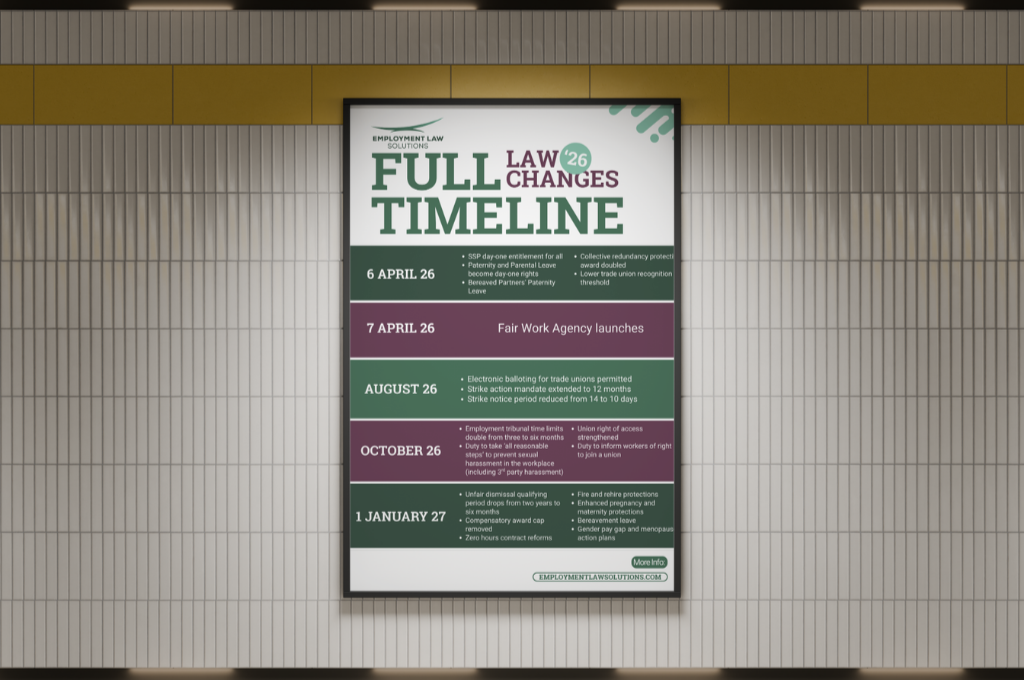
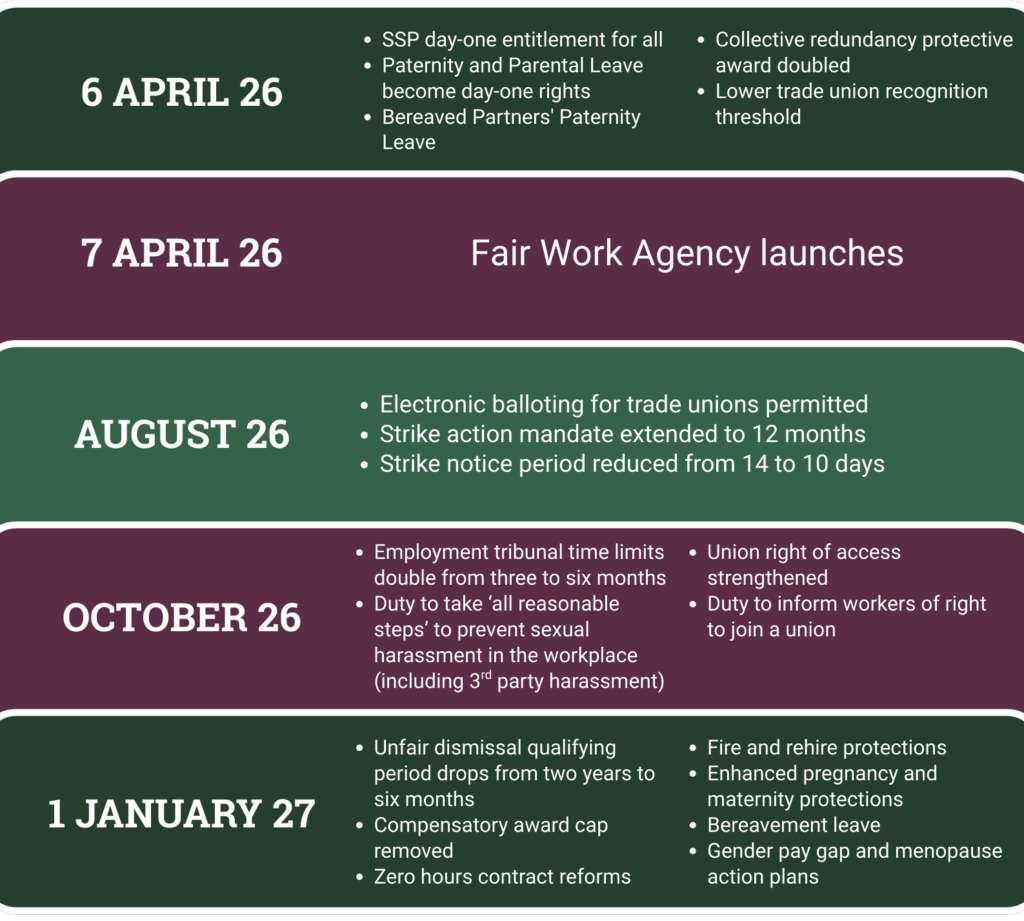
Employment Rights Act 2025: Full Implementation Timeline
The timeline below summarises every significant change and when it takes effect.
April 2026: The First Wave of Changes
Statutory Sick Pay: Day-One Entitlement for Every Employee
From 6 April 2026, Statutory Sick Pay (SSP) is payable from the first day of sickness absence to all employees, regardless of their earnings or contracted hours. The Lower Earnings Limit, which previously excluded low-paid workers from SSP entitlement, is abolished. The three-day waiting period is also removed.
In practice, every employee on your payroll, however few hours they work or however low their pay, is entitled to SSP from day one of incapacity. Employers should review sick pay policies, update contracts of employment, and budget for increased SSP liability, particularly where the workforce includes large numbers of part-time or lower-paid staff.
| From 6 April 2026, SSP applies to every employee from day one of sickness. There is no earnings threshold and no waiting period. Review your policies now.
Paternity Leave and Parental Leave Become Day-One Rights
Currently, employees need 26 weeks of service to take Paternity Leave and 12 months before they qualify for Unpaid Parental Leave. From 6 April 2026, both become day-one rights. A new employee can take Paternity Leave from their first week if the other qualifying conditions are met.
A new entitlement, Bereaved Partners’ Paternity Leave, also comes into force. This gives fathers and partners up to 52 weeks of paternity leave where the mother or primary adopter dies within the first year of the child’s life.
All family leave policies should be reviewed and updated before April 2026. Many existing policies reference the old qualifying periods and will be non-compliant from the commencement date.
Collective Redundancy: Protective Award Doubled
The maximum protective award payable where an employer fails to carry out proper collective consultation doubles from 90 days’ pay per employee to 180 days’ pay per employee. The financial risk of getting collective redundancy consultation wrong has increased significantly. Employers who carry out redundancies involving 20 or more employees should ensure their processes are legally compliant before proceeding.
The Fair Work Agency: A New National Enforcement Body
From 7 April 2026, the Fair Work Agency (FWA) comes into existence as a single national enforcement body. It consolidates three previously separate functions under one roof: HMRC’s National Minimum Wage enforcement team, the Employment Agency Standards Inspectorate, and the Gangmasters and Labour Abuse Authority.
The FWA has powers to investigate employers on its own initiative or in response to worker complaints, issue enforcement notices, pursue civil proceedings, and name and shame non-compliant employers publicly. This represents a material step change in enforcement capability. Employers should ensure their NMW calculations, holiday pay calculations, and agency worker arrangements are fully compliant before 7 April.
Trade Union Recognition: A Lower Threshold
The threshold for trade unions to achieve statutory recognition is substantially reduced from April 2026. Unions no longer need to demonstrate they are likely to win a recognition ballot. They simply need to show that 10% of the proposed bargaining unit are members. The 40% workforce support requirement for recognition ballots is removed, and only a simple majority of those who vote is required.
Employers who currently operate without a recognised trade union should not assume they are immune from these changes. A review of workforce union membership levels is a prudent step.
August 2026: Electronic Balloting for Trade Unions
From no earlier than August 2026, trade unions will be permitted to conduct statutory ballots electronically or in person, rather than exclusively by post. This removes a longstanding administrative barrier to union participation, making it significantly easier for members to vote in industrial action and recognition ballots.
Combined with the removal of the 50% turnout requirement from April 2026 and the extension of industrial action mandates from six to twelve months, the conditions for lawful industrial action are now more favourable to unions than at any point since the 1990s.
| A successful strike ballot mandate now lasts 12 months. The notice period before strike action reduces from 14 to 10 days. Employers should review their industrial relations response plans now.
Employers should review their industrial action response plans and consider what contingency arrangements they have in place. Doing so now, rather than after a ballot is called, is significantly more effective.
October 2026: Rights Revolution
Employment Tribunal Time Limits Doubled
The time limit for bringing an employment tribunal claim increases from three months to six months for all claim types. This is a significant change. More claims will be brought. Employees who currently miss the three-month window will have an extended opportunity to pursue them.
For employers, the practical implication is clear: documentation matters more than ever. All dismissal files, disciplinary correspondence, investigation notes, and outcome letters should be retained for a minimum of six months after the relevant event, and longer in practice given potential delays in the tribunal system.
The Duty to Take ‘All Reasonable Steps’ to Prevent Sexual Harassment
The current duty on employers to take ‘reasonable steps’ to prevent sexual harassment increases to ‘all reasonable steps’ from October 2026. The duty is also extended to cover harassment by third parties, including customers, clients, contractors, and suppliers.
Employment tribunals will be able to uplift compensation by up to 25% where an employer has failed to take all reasonable steps. October 2026 is also when the Government will publish regulations setting out what ‘all reasonable steps’ means in practice.
Employers should act now rather than wait for those regulations. The following steps are advisable before October 2026:
- Conduct and document a written sexual harassment risk assessment.
- Review and update the harassment and dignity at work policy.
- Deliver training for managers and all staff on recognising, reporting, and responding to sexual harassment.
- Establish a clear and accessible reporting mechanism for harassment concerns.
- Review any non-disclosure agreements, which are void to the extent they prevent disclosure of harassment.
Trade Union Rights: The October 2026 Package
October 2026 brings a suite of additional trade union rights into force: a new positive duty on employers to inform all workers of their right to join a trade union; a strengthened right of access for unions to workplaces; strengthened paid time off rights for union representatives; and new protections against detriment for workers taking protected industrial action.
The duty to inform workers of their right to join a union is a simple but important compliance step. Employers should issue an all-staff communication on this point before October 2026.
January 2027 and Beyond: The Biggest Changes Are Still Coming
The changes arriving in 2027 are in many respects the most significant of the entire Employment Rights Act 2025 programme.
Unfair Dismissal Qualifying Period Drops to Six Months
From 1 January 2027, the qualifying period for unfair dismissal protection reduces from two years to six months. At the same time, the cap on the compensatory award in unfair dismissal claims will be removed entirely.
In practical terms, an employee dismissed with six months and one day of service will have the full range of unfair dismissal rights, and there will be no ceiling on the compensation a tribunal can award. Probationary procedures will need to be robust, well-documented, and genuinely effective within a six-month window. Many employers’ current approach to managing new starters will need to change significantly before this date.
Zero Hours Contract Reforms
Zero hours contract reforms will restrict the exploitative use of zero hours arrangements. Workers on zero hours contracts will have the right to a contract reflecting their regular hours, reasonable advance notice of shifts, and compensation for short-notice cancellations. This is a major change for businesses in hospitality, retail, and social care that rely heavily on flexible staffing models.
Further 2027 Changes
Other changes arriving in 2027 include fire and rehire protections (making it significantly harder to dismiss and re-engage staff on worse terms); the collective redundancy threshold being calculated across the whole organisation rather than individual establishments; enhanced pregnancy and maternity protections; a new right to bereavement leave including for pregnancy loss; strengthened flexible working consultation requirements; and mandatory gender pay gap and menopause action plans.
| The January 2027 changes are less than ten months away. Employers who start preparing their probationary processes and zero hours arrangements now will be significantly better placed than those who do not.
What Should You Do Now? A Practical Action List
The following steps represent a practical starting point for every employer:
- Review sick pay policies, sick pay clauses in contracts, and any enhanced sick pay schemes before April 2026.
- Audit all paternity, parental leave, and family leave policies and update them to reflect day-one rights before April 2026.
- Ensure NMW calculations, holiday pay calculations, and agency worker arrangements are compliant before the Fair Work Agency launches on 7 April 2026.
- Train managers on the new trade union recognition threshold and on the employer’s obligations if a union approaches the business.
- Update disciplinary, grievance, and redundancy procedures.
- Conduct and document a sexual harassment risk assessment before October 2026.
- Issue an all-staff communication about the right to join a trade union before October 2026.
- Update your document retention policy: all dismissal-related correspondence and records should be retained for a minimum of six months.
- Begin reviewing and strengthening probationary processes now, ahead of the January 2027 unfair dismissal qualifying period change.
- If your business uses zero hours contracts, begin planning how to adapt your staffing model to the 2027 requirements.
How Employment Law Solutions Can Help
Employment Law Solutions is a retained HR, employment law, and health and safety consultancy based in Cheshire, working with SMEs across the UK. Our retained clients receive unlimited day-to-day employment law and HR advice, access to our documentation library, representation support, and a dedicated adviser who understands their business.
We can help you navigate every aspect of the Employment Rights Act 2025, from policy reviews and contract updates to manager training, redundancy support, and employment tribunal representation.
| Book a free consultation with our team at employmentlawsolutions.co.uk and make sure your business is ready for everything that 2026 and 2027 have in store.
This blog post is for general information purposes and reflects the Government’s confirmed implementation timetable as published in February 2026. It does not constitute legal advice. Employment Law Solutions Limited, Cheshire.